How does the mind represent what is no longer there?
We study how perception becomes memory—and how memory guides attention, decisions, and action.
Memory is limited.
Its consequences are not.
Our work connects the fidelity of internal representations to the choices people make, the effort they expend, and the neural systems that sustain experience over time.
What survives?
We separate whether an item is retained from how precisely its features are represented.
What guides action?
Continuous behavior reveals how remembered and incoming information compete over time.
What makes memories distinct?
Neural and computational approaches link representational geometry to memory fidelity.
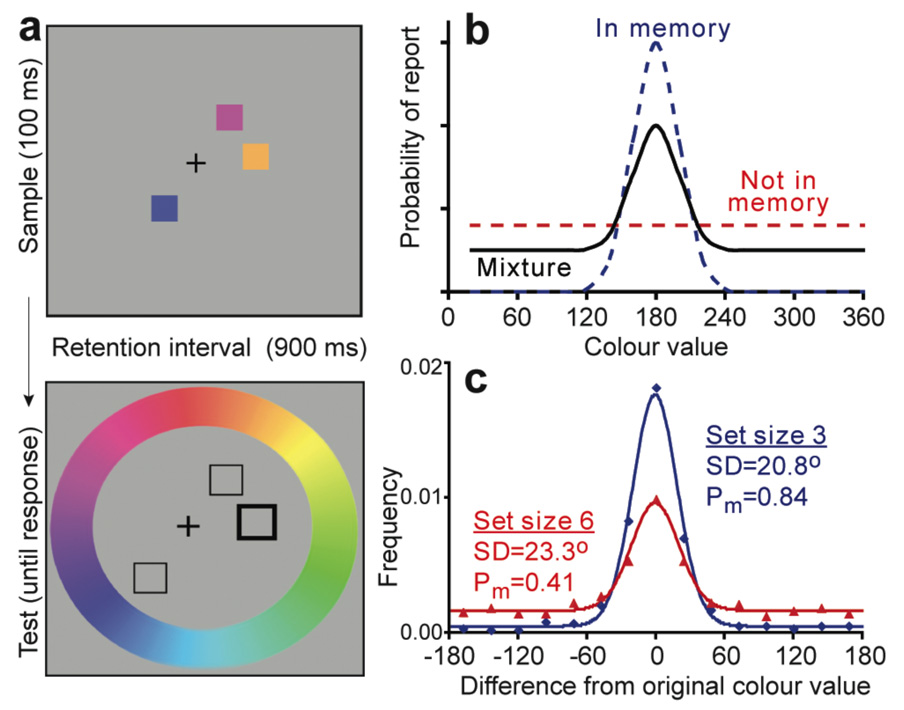
Separating capacity from precision
A continuous-report framework developed in our laboratory distinguishes the probability that a visual item is retained from the fidelity of its remembered features. This distinction has reshaped how visual working memory is measured and modeled.
Read Zhang & Luck (2008)From behavior
to mechanism
No single measure is sufficient. We combine experimental, computational, physiological, and translational approaches to test the same theoretical questions at different levels.
Inside the lab
New findings, milestones, and the people advancing the science of memory.