From fleeting perception to durable representation
We investigate how information is selected, maintained, transformed, and used—connecting representational fidelity to neural mechanism and real-world behavior.
What is the structure of a memory?
Our research asks how the mind selects, maintains, and uses information to guide behavior. We seek to explain not only how much information people remember, but how faithfully it is represented, what it costs to maintain, and how it changes decisions in real time.
We combine psychophysics with computational modeling, continuous behavioral measures, functional MRI, intracranial EEG, and noninvasive brain stimulation. Converging evidence connects mental representations, neural mechanisms, and consequential behavior.
The nature and precision of visual working memory
Visual working memory keeps a small amount of information active after it disappears. Our work distinguishes a limited number of retained representations from the precision with which each item is remembered.
Remembering an item and remembering it precisely are separable properties.
We continue to investigate how capacity and precision vary with task demands, individual differences, and the structure of visual information.
Zhang & Luck, 2008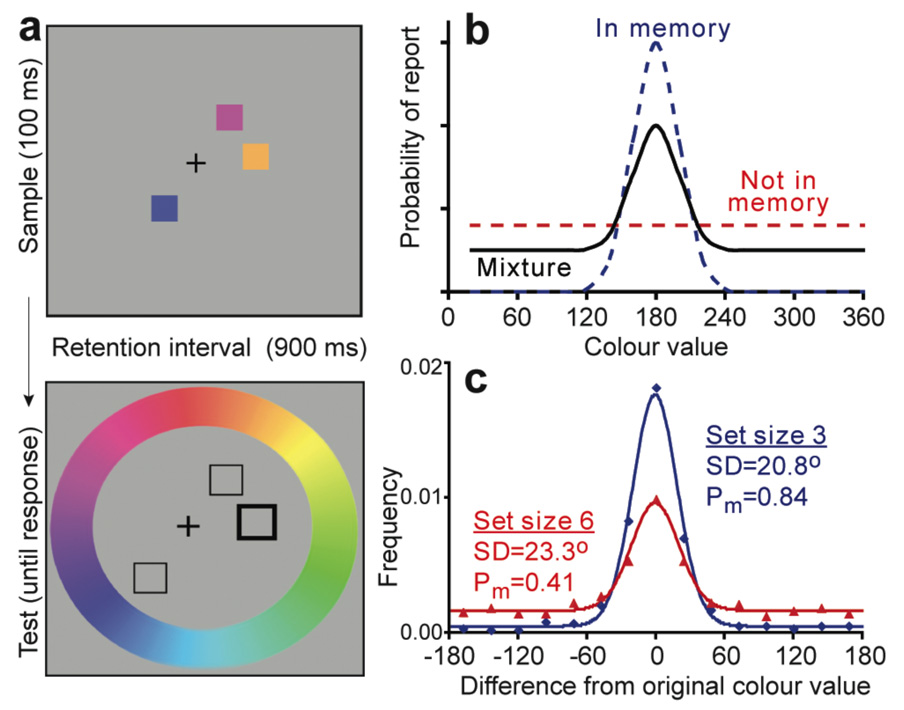
Cognitive effort and subjective value
Remembering is not only capacity-limited; it can also feel effortful. We use calibrated physical exertion as a quantitative probe of the subjective cost of cognitive work.
Cognitive and physical effort can be compared on a common decision scale.
This framework creates new ways to study motivation, aging, time perception, and the avoidance of cognitively demanding tasks.
Xie & Zhang, 2023
Continuous motor dynamics as a window into cognition
A final button press conceals the competition that produced it. Mouse trajectories and other continuous actions reveal how perception, attention, and memory evolve moment by moment.
Movement provides a continuous readout of competing internal representations.
We use these dynamics to examine memory-guided attention and the balance between global and local processing in applied tasks.
Park & Zhang, 2024
Neural mechanisms of mnemonic precision and similarity
How does the brain preserve the exact features of an experience while keeping similar memories distinct? We investigate the hippocampus and entorhinal cortex as systems for maintaining precision and separating overlapping representations.
Neural population codes can be related to memory fidelity on individual trials.
Functional MRI, intracranial electrophysiology, and brain stimulation connect representational geometry to behavior.
Xie et al., 2023
Memory in the real world
Laboratory measures become most meaningful when they explain behavior outside the laboratory. We examine how emotion, familiarity, sleep, social context, and individual differences influence memory and decision-making.
Representational limits help explain consequential individual and social behavior.
This work connects cognitive mechanisms to health behavior, loneliness and well-being, and executive functioning across the lifespan.
Xie, Campbell, & Zhang, 2020
One problem.
Multiple levels of explanation.
Our laboratory values converging evidence, open methods, and theoretical precision. Explore the publications behind these research themes or learn about the people conducting the work.