
We are pleased to share our new eLife Reviewed Preprint, Working Memory Guides Perceptual Decisions Through Fast Capture and Slow Drift, by Hyung-Bum Park and Weiwei Zhang.
How does information held in working memory shape what we see—and how can current perception reshape what we remember? Across two experiments, participants remembered a color while completing a perceptual color-matching task. Continuous mouse trajectories captured how their decisions evolved moment by moment.
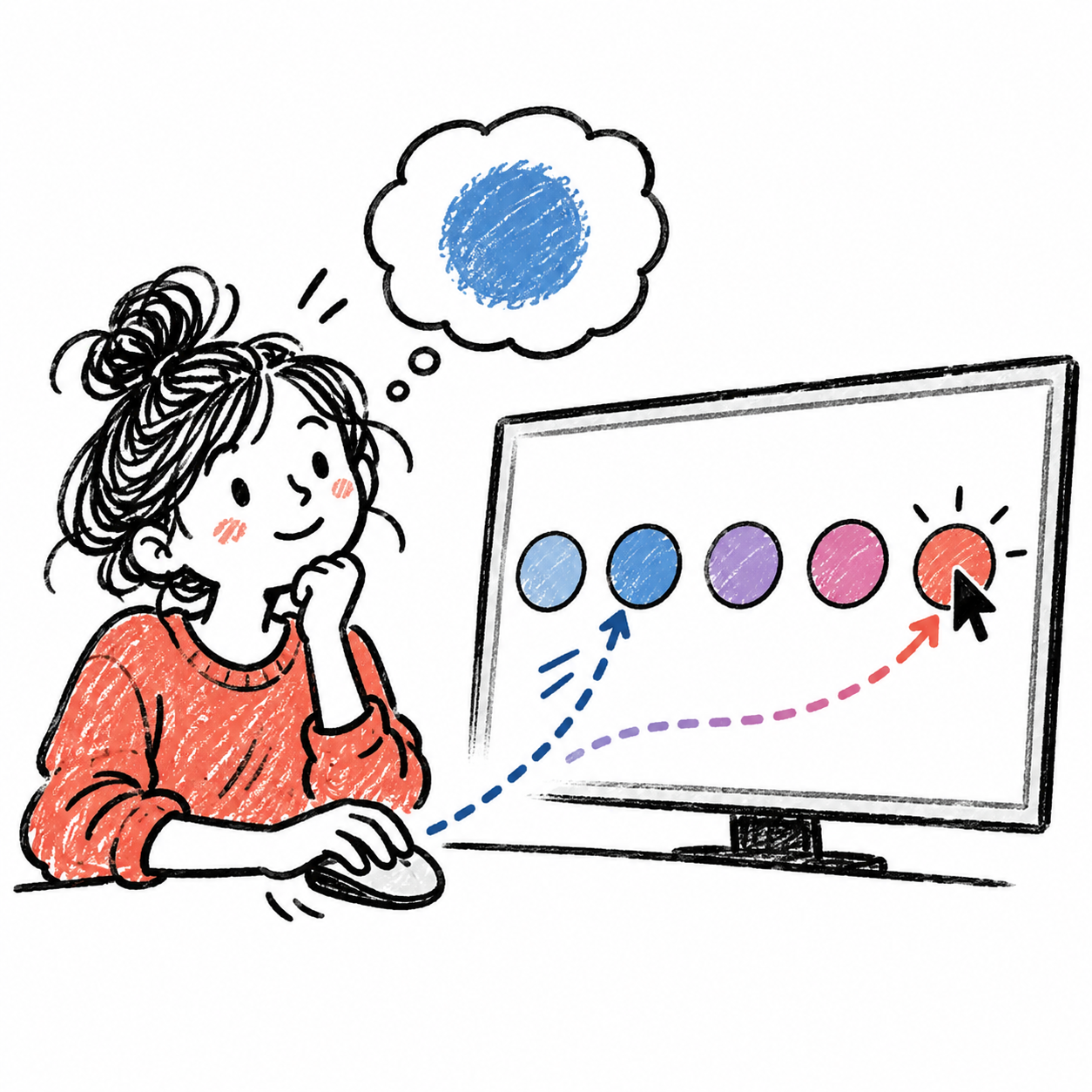
Hierarchical Bayesian modeling showed robust bidirectional attraction between working memory and perception. Mouse trajectories further separated two processes: an early, transient deviation consistent with fast attentional capture, and a slower, sustained drift that closely tracked the final perceptual report. Working memory’s prospective influence on perception contained both components, whereas perception’s retrospective influence on later memory was expressed mainly through sustained drift.
These findings show that working memory is not merely a short-term storage system. It acts as an active prior that shapes perceptual decisions through distinct processes operating over different timescales. The study also demonstrates how continuous mouse tracking can reveal cognitive dynamics hidden by endpoint measures alone.
